Hiển thị các bài đăng có nhãn Flatey. Hiển thị tất cả bài đăng

Chủ Nhật, 11 tháng 1, 2015

The Snæfellsnes Peninsula

Lush fjords, haunting volcanic peaks, dramatic sea cliffs, sweeping golden beaches and lava flows make up the landscape of the 100km long Snæfellsnes Peninsula.

The Snæfellsnes Peninsula

It has been named Iceland in Miniature, because many national sights can be found in the area, including the Snæfellsjökull volcano, regarded as one of the symbols of Iceland. With its height of 1446 m, it is the highest mountain on the peninsula and has a glacier at its peak.

Top Places we recommend to visit in Snæfellsnes Peninsula

1. Gerduberg basalt columns

An impressive wall of beautiful basalt columns, forming geometric patterns in the cliffs. Location: 46 km from Borgarnes on the way to Snaefellsnes peninsula (Road nº54).

The Snæfellsnes Peninsula

2. Arnarstapi

Arnarstapi or Stapi is a small fishing village at the foot of Mt. Stapafell between Hellnar village and Breiðavík farms on the southern side of Snæfellsnes, Iceland. Arnarstapi was an important trading post in the past and had a much bigger population than it has now.

A very interesting old path follows the coastline where you can see old lending places of fishermen, lots of birds, like the kittiwake, the Arctic tern and the fulmar and pass through a lavafield. If you take a guided tour, you will also hear a ghost story.

The Snæfellsnes Peninsula

Arnarstapi is the best place to organize an advent to the glacial crown. Snowmobile tours on the glacier are run by Snjófell. Location: on the southern side of Snæfellsnes peninsula, 119 km from Borgarnes (Road nº574)

3. Gatklettur - Arch Rock

Gatklettur is a cliff with a circular arch. Rock Arch shows how distinctive wave action has eroded the rocks into arches and beautifurl swirled patterns.There is great birdlife around the cliffs and pretty flora surrounding the area. Location: near Arnarstapi, south east of Snaefellsjokull glacier (Road nº574).

The Snæfellsnes Peninsula

4. Snæfellsjökull National Park

The park was established on June 28, 2001 and it is one of the most visited parks in Iceland. Considered by many to be the jewel of West Iceland, Snaefellsjokull is the most famous volcano in Iceland.

The Snæfellsnes Peninsula

It is an active volcano and provided the setting for Jules Vernes famous book Journey to the Centre of the Earth. Many believe the glacier to be one of the seven main energy centres of the earth and its mystique is noticed by many. Undisputedly the main attraction of the National Park.

The Snæfellsnes Peninsula

Excursions onto the glacier are offered from the village Arnarstapi on the southern side. The magnificent view from the top extends to Reykjanes Peninsula on the south side and the West Fjords on the north side as well as over the mountains of Snaefellsnes to the east.

A landmark: can be seen from many places, e.g. Reykjavik, 180 km away (Road nº570).

5. Djupalonssandur & Dritvik

Djupalonssandur is a beautiful pebbled beach, with a series of rocks of mysterious form emerging from the ocean.

It is one of the few areas that lead down to the sea along this coast with its high dramatic cliffs. Watch out for the famous ghosts roaming the place! Location: South of Snaefellsnes glacier, 10 km from the village Hellnar (Road nº574).

The Snæfellsnes Peninsula

6. Ytri Tunga

The beach near the abandoned farm of Ytri Tunga is well-known for its seal colony. The seals are friendly and curious and will climb up on the rocks near the sandy beach.Sometimes you have to be patient and wait for them.

The Snæfellsnes Peninsula

The best time to see seals is in June and July. A beautiful, serene cove with a wonderful view of the Snaefellsjokull Glacier. Location: on the southern side of Snaefellsnes peninsula, by road no. 54, 15 km before Hotel Budir.

The Snæfellsnes Peninsula

7. Vatnshellir Cave

Follow the path of the lava flow in the 8000 years old cave located in Snæfellsjökull National Park.  All guests will be equipped with lights and helmets. Very well accessible for most people. We recommend warm clothing, hiking shoes and gloves.

The Snæfellsnes Peninsula

During summer, 45 minute guided tours from 10am-6pm, every hour on the hour. In wintertime tours are offered for groups (12+ persons) on an agreement. Price for adults: ISK 2000,-

Further info: vatnshellir@vatnshellir.is  www.vatnshellir.is  +354-665-2818

The Snæfellsnes Peninsula

8. Flatey Island

Flatey means "flat island". The old houses, shops and warehouse buildings on Flatey reflect the optimism and development of the period around 1900. In former times, the island was important both as a fishing centre and as the hub of commercial life of the Breidafjordur area. Traders from the Hanseatic League in Germany ran a trading post here.

The Snæfellsnes Peninsula

The first Icelandic trader received a temporary licence in 1589, and in 1777 Flatey received a charter as a town. Flateyjarbok (the Book of Flatey), one of the most important and impressive of the ancient Icelandic saga manuscripts, was preserved on Flatey in the Middle Ages. A photocopy reproduction is on display in the library (the oldest one in Iceland, built in 1864 in the heyday of Flatey's prosperity).

The Snæfellsnes Peninsula

The church on Flatey dates from 1926. The frescoes in the apse were painted by Kristjana and Baltasar Samper and are based on the local landscape and traditional occupations. Flatey has been an inspiration to many artists and the film "The Bridegroom" (Brudguminn) by Baltasar Kormákur was filmed on Flatey in 2007.

The Snæfellsnes Peninsula

Berglind Rós, Iceland24
January 2015

Chủ Nhật, 6 tháng 4, 2014

The islands of Iceland

Iceland has surprisingly few islands big enough to explore and/or live on. This probably has something to do with how the country was made. The islands we do have, however, add a little bit of extra adventure to any exciting holiday in Iceland.


Iceland’s neighbours across the sea in places like Scotland and Norway seem to be absolutely awash with islands; but then they are physically older landmasses where erosion has been busily breaking up the rocks and currents have consistently been piling up sand and silt into monumental mounds – many of which are now islands.

Iceland, on the other hand, is a volcanic land still being created from a seam between tectonic plates as they move apart. As the lava bubbles up to fill the gaps, we are left with a remarkably circular shaped country, compared to most. As well as this, the forces of nature have not had a very long time to work on island building so far.


Iceland can boast about 30 so-called ‘big islands’ ranging from 13.4 sq. km down to 20 sq. m. We have thousands of rocks and skerries as well, but they are classified as ‘small islands’ and not therefore counted.

Of Iceland’s 30 main islands, nine are of particular interest and can be visited, or viewed from offshore. That number is ten, if you include the island of Iceland itself…Here they are:

1. Heimaey

This is the only one of South Iceland’s Westman Islands (Vestmannaeyjar) which is inhabited by humans. Actually the island has one of Iceland’s bigger towns on it and is worth visiting just for that. But Heimaey is famous for two things above all else: puffins and the big scary 1973 volcanic eruption. The former nest on the island in numbers not seen anywhere else on the planet and the latter kept the islanders away from home for nearly seven months and destroyed a lot of houses. Now you can explore some of those houses, Pompeii style.


2. Hrísey

This delightful, peaceful little island is full of history and has been permanently inhabited since the settlement of Iceland. It is the second biggest island off the mainland and only 15 minutes’ ferry ride from the mainland. The island is today part of the Akureyri municipality and its 170 inhabitants are mostly famous for the seafood they create – especially the beautiful mussels.


3. Grímsey

A fair way further offshore out to the north lies Grímsey – famous mostly for being the only part of Iceland to cross the Arctic Circle*. It’s one of those little human landmarks that we like to go to. See the line. Jump over the line. Jump back again. Take a photo straddling the line. You know how it goes. Fishing and tourism are the 90 inhabitants’ main livelihood.


4. Viðey

Viðey is less than five minutes by boat from Reykjavík. It has a lovely cliffy beach to explore, a small adventure playground, a café and the renowned Lennon Ono Imagine Peace Tower, which is very much worth seeing, even when the lights are turned off.


5. Surtsey

Surtsey is another one of the Westman Islands. Although it wasn’t before 1963. The volcanic eruption that created the island lasted until 1967 and Surtsey has been a natural laboratory ever since, allowing scientists to study how life colonises new land. As a result, you can’t go there. Sorry. But you can get close to it on a boat.


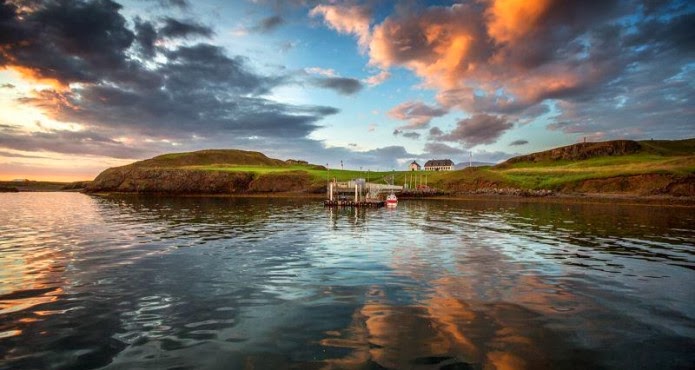
6. Flatey

Flatey in Breðafjörður is the quintessential image of rural Icelandic charm. The green agricultural island has a winter population of just five people, but many more in the summer. The ramshackle, but welcoming village was the set for the Icelandic comedy film Brúðgumminn. The ferry between Snæfellsnes and the Westfjords stops at Flatey and it makes a great overnight stopover.


7. Vigur

Vigur island is one of the Westfjords town of Ísafjörður’s biggest attractions. The island is not in the town, but the ferry departs from there… Vigur is famous for the quality of the farmer’s cakes and waffles, for having the smallest post office in Europe, and for its eider ducks, which are quite unafraid of people and provide some of the world’s most valuable and sought after eider down.


8. Kolbeinsey

This is one you almost certainly can’t visit. It is a tiny rock way above the Arctic Circle famous for nothing more than being Iceland’s northernmost point. In the name of frontier building and political shenanigans, Iceland built a helipad on the rock – which is almost the same size as the whole island. By regularly landing Coastguard helicopters on the island, Iceland proves its sovereignty of the island. At least that was the idea before the helipad crumbled into the sea. The whole island may not be far behind it.


9. Lundey

Lundey is another one just off the coast of Reykjavík, and another one you unfortunately can’t go and walk on. But if you take a whale watching tour, there is a very big chance you’ll stop very close to the island to observe all the nesting puffins from a safe distance. The island’s name means Puffin Island – and that’s precisely what most tour guides call it.


Source: Wow Magazine
Iceland24, April 2014